

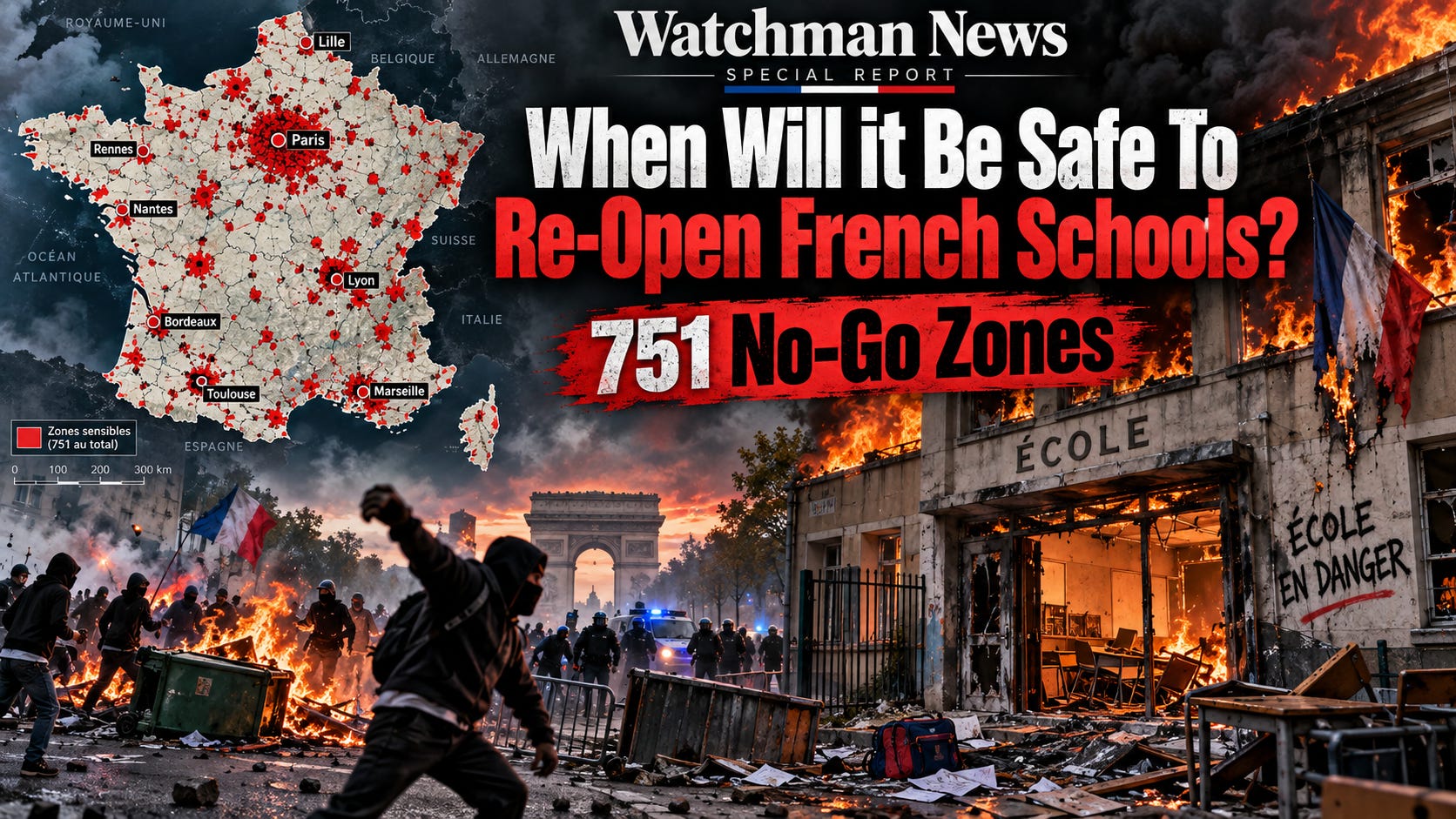
The Official 751 No Go Zones of France, the 3,000 Mosques, and suicide of a defeated country. My commentary as someone who was expelled for “extreme right wing activism”.
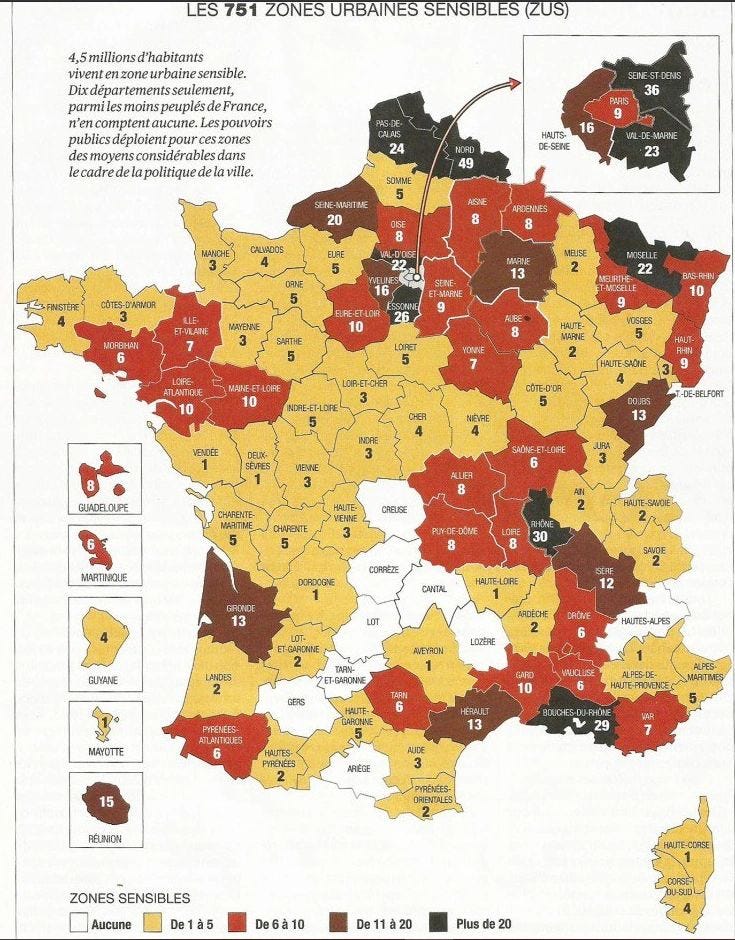
When I was living in a neighboring country of France from 2005 onwards, people everywhere were talking about the possibility of civil war there, especially with the 751 No-Go zone Islamist areas. There were a lot of crack-downs, some of them also affected me legally with Government threats to my family, which caused me to need to self-censor at the time or face expulsion (again).
Since I have that accomplishment under my belt, I have lended my skills as a Peace Envoy / Liaison aimed toward militant groups to go into peace settlements.
For these efforts I founded the Priory of Salem, Institute of Peace Studies which has maintained a good deal of studies of peaceful solutions. Each solution has a multi-generational aspect. Sober thoughts on the results in either direction are laid out. Law and order is not abandoned for leftist extreme politics.
We applaud US Secretary Marco Rubio for his statements about saving the West from it’s impending death. A lot of these have not been popular but they deal with the facts, even when sometimes they sound controversial. I must remind a recent report of our was circulated by Watchman News entitled ““DEFEND EUROPE” Official Trump policies” and the Remigration Summit 2026 Renews Debate Over Sovereignty, Identity, and Europe’s Constitutional Future
Along with reports agreeing with America’s official Department of War policies regarding the impending “Civilizational Erasure” as these injustices against indigenous European Christians continue, as found in this circulated report: https://watchman.news/2026/04/eu-debating-us-over-western-stability-the-civilizational-erasure-trajectory/
So we are not only seasoned for the last 20 years, but keep up to date with all the developments.
These 751 areas in France aren’t the only issue. As a Peace Institute we have made approaches to the Islamic leadership to try to reach “peace negotiations” to reign-in their youths, and as they separate out we also may then have access to correct those of our own. These areas, also called Sensitive Urban Zones (Zones Urbaines Sensibles, or ZUS) now have a whole additional generation or two that protect their criminal practices.
Is School Permanently Over in Parts of France?
A Reality Check on the Student Revolt, Classroom Destruction, and Europe’s Growing Crisis of Public Order
Watchmen News | Special Report | October 8, 2026
Prepared for Watchmen News, with policy analysis for the Priory of Salem Institute of Peace Studies
When the classroom becomes a battleground
What happens when the school itself becomes a place where education can no longer take place?
This is the question France must now confront as an extraordinary wave of student unrest spreads through its educational system.
Across the country, schools have been blockaded, property vandalized, buildings set on fire, and students and police drawn into increasingly serious confrontations. By early October, hundreds of secondary schools had been forced to suspend lessons either fully or partially, while some suffered damage requiring more than simply unlocking the gates and inviting pupils back inside.
France’s education minister reported that 24 schools had been burned or ransacked. Hundreds more experienced closures or disruptions. In some communities, the ordinary school day has been replaced with barricades, sirens, police deployments, and uncertainty.
The important question is no longer simply when the protests will end.
It is whether the institutions, discipline, and public confidence necessary for normal education can be restored.
A crisis measured in hundreds of schools
The dimensions of the upheaval are remarkable.
On October 1, more than 1,020 French high schools were affected by strikes or demonstrations, according to figures reported by Le Monde. By October 5, between 400 and 500 schools were expected to remain fully or partly closed.
The protests began around September 21, initially driven by complaints about missing teachers and deteriorating educational conditions in the Paris region. They rapidly spread to cities and communities across France.
Students have cited overcrowded classrooms, teacher shortages, excessive school hours, insufficient facilities, and worsening educational opportunities.
These grievances deserve to be examined seriously. A government that promises public education has an obligation to provide adequate facilities, qualified teachers, and reasonable conditions for learning.
But legitimate complaints do not confer a right to destroy classrooms, threaten educators, or deprive other children of their education.
A distinction must be made between peaceful students demanding reform and those participating in intimidation, arson, and criminal destruction.
The right to protest cannot become the right to prevent everybody else from attending school.
The missing classroom: What happens after the violence?
Suppose authorities succeed in clearing the streets tomorrow.
Would the crisis be over?
Not necessarily.
A school whose doors have been burned, equipment destroyed, or staff intimidated cannot necessarily resume operations the following morning.
Repairing buildings costs money. Replacing computers, furniture, and teaching equipment takes time. Rebuilding confidence among parents and teachers may take considerably longer.
And there is another problem.
What happens when the students responsible for serious violence are identified?
Should they simply return to the same classrooms, alongside the pupils and teachers who experienced the destruction?
Should a child who wants to attend school safely be expected to tolerate the continuing presence of those who have threatened that safety?
There must be individual accountability and due process, particularly where minors are concerned. Yet a school system that cannot impose meaningful consequences risks losing authority altogether.
Expulsion is not, by itself, an educational policy. France must also provide lawful alternatives, supervised placements, rehabilitation where appropriate, and practical arrangements for the continuing education of minors.
The administrative challenge is substantial. Students cannot always be reassigned immediately to neighboring schools. Capacity, transport, staffing, specialist provision, and local educational arrangements all place limits on what can be accomplished overnight.
This is where a temporary breakdown can become a prolonged institutional crisis.
Did the COVID generation experience a developmental rupture?
One question warrants particular investigation.
Could today’s unrest be partly connected to the educational and social interruptions experienced during the COVID-19 pandemic?
Many of the students now attending French secondary schools spent formative years under extraordinary conditions: interrupted education, social restrictions, remote learning, and disrupted daily routines.
Researchers have documented educational and developmental consequences of the pandemic in several European countries. The long-term effects continue to be studied.
But there is a difference between demonstrating lasting pandemic effects and proving that COVID restrictions caused the present violence.
Our hypothesis is that pandemic-era disruption may be one contributing factor in a generation’s relationship with classroom discipline, institutional authority, and social expectations.
It is worth asking whether interrupted routines, excessive dependence on digital interaction, weakening school attachment, and an accumulation of grievances have affected students’ willingness to accept conventional classroom environments.
This hypothesis requires research rather than assumption.
Nevertheless, it would be shortsighted to ignore the possibility that European governments are still dealing with educational consequences from decisions made years ago.
France’s deeper social experiment: Integration, identity, and national cohesion
A second, more politically sensitive question concerns the long-term transformation of French society.
For decades, France has experienced immigration, demographic change, social segregation, and recurring disturbances in some disadvantaged urban districts.
These subjects have become politically difficult to discuss without immediate accusations or counteraccusations.
Yet the questions cannot simply be discarded.
How successfully has France integrated successive generations into a common civic identity? Do young people from different backgrounds experience a meaningful sense of belonging to the French Republic? Are schools succeeding in teaching shared civic responsibilities alongside individual rights?
These questions concern public policy, national cohesion, and institutional legitimacy.
They must not become a presumption that French children of African or other immigrant ancestry are inherently less loyal, or responsible for the current disturbances. Ancestry is not evidence of criminal behavior, and the current student movement crosses different neighborhoods, socioeconomic groups, and political constituencies.
Nor do the available reports establish immigration as the principal cause of the October 2026 unrest.
However, France’s historical difficulties with segregation, integration, poverty, and distrust between certain communities and state institutions remain relevant areas of investigation.
For a peace studies institute, an especially important question is whether France’s model of civic integration has succeeded in producing a sufficiently shared understanding of citizenship, rights, responsibilities, and peaceful conflict resolution.
The strength of a nation is not determined simply by the ancestry of its citizens, but by whether its institutions can secure their confidence and cooperation.
When confidence in common institutions deteriorates, the consequences can be severe.
When protest becomes a substitute for government
France also faces a crisis of political leadership.
A government that cannot supply teachers, maintain schools, or respond credibly to grievances creates the conditions for mounting frustration.
But political leaders who excuse violence because they sympathize with a particular protest movement create an additional danger.
Public officials have a duty to distinguish peaceful political expression from conduct that endangers lives, destroys public property, and deprives children of education.
The appropriate response is neither unlimited repression nor unlimited tolerance.
Police misconduct must be investigated, especially where minors have suffered serious injuries. Reports of excessive force deserve proper judicial scrutiny.
At the same time, those who burn buildings, assault school personnel, or organize violent intimidation must face proportionate legal consequences.
These responsibilities are complementary, not contradictory.
A country cannot preserve civil liberties by abandoning public order, nor preserve legitimate authority by disregarding the rights of its citizens.
Could schools remain closed indefinitely?
This is the question that should concern every European parent.
At present, no credible evidence establishes that France has decided to close its school system permanently. Most of the documented closures are temporary disruptions, security-related suspensions, or protest blockades.
Nevertheless, the possibility of recurring or prolonged closures deserves serious consideration.
Imagine a school reopened after several weeks of repairs, only to experience another blockade, another fire, or renewed threats against teachers.
How many times can local authorities restore operations before parents lose confidence?
How many teachers will tolerate increasingly dangerous working conditions?
At what point do temporary disruptions amount to a practical denial of education, even if the school remains officially open?
A school need not be permanently closed by government decree to become effectively unavailable to the children who depend on it.
This is the distinction that France, and the wider world, should be examining.
A warning for the rest of Europe
The French situation should not be viewed simply as another episode of street demonstrations.
The issues involved—public spending, educational decline, social integration, youth alienation, political polarization, and diminishing confidence in institutions—are not unique to France.
Similar tensions can emerge wherever a government loses the ability to maintain both public services and the rule of law.
For neighboring countries, including Belgium and the Netherlands, the question is not whether they will necessarily experience the same unrest.
It is whether their educational, civic, and political institutions are prepared to prevent legitimate grievances from developing into destructive confrontation.
A functioning school system requires far more than buildings and teachers. It requires an underlying social agreement that education is worth protecting.
Once that agreement breaks down, greater spending alone may not restore it.
The path to restoring order
The French government must now demonstrate that it can meet several obligations simultaneously.
It must protect the right of students to attend school. It must repair damaged facilities and provide adequate teachers. It must investigate criminal destruction and any unlawful use of force. It must hold individuals accountable without punishing innocent students collectively.
Above all, it must restore the principle that disagreements are to be resolved through lawful civic processes, not through the destruction of shared institutions.
There is no lasting peace where legitimate grievances are ignored.
There is also no lasting peace where violence becomes an accepted method of negotiating with the state.
France stands at a significant turning point.
Will schools reopen safely and resume their educational mission? Will the deeper problems be investigated and addressed? Will classroom discipline, mutual respect, and civic confidence recover?
Or will repeated shutdowns and confrontations become an established feature of French education?
The world should watch carefully.
Because the most serious question is not whether school has ended permanently in France. It is whether the next generation can still depend upon the institutions that are supposed to prepare them for the future.
Watchmen News — International Social Affairs and Peace Studies Commentary
In Christ’s eternal service,
+Rev Dr Stephen M.K. Brunswick, ThD, PhD
Primace at St Andrew’s OCC
Editor at Watchman News
Dean at Priory of Salem, Institute of Peace Studies
Phone: +1 (866) 477-6811
Email: info@st-andrewsocc.org
Web: https://St-AndrewsOCC.org
Post: St Andrew’s PO Box 59, Nevada, MO 64772
UNITED STATES OF AMERICA

Presiding Bishop, AOCC Benelux (2015-Present)
Primace, Orthodox Church of the Culdees (2009-Present)
Pastor, TCA WW (2001-Present)
+ Oremus pro invicem +