

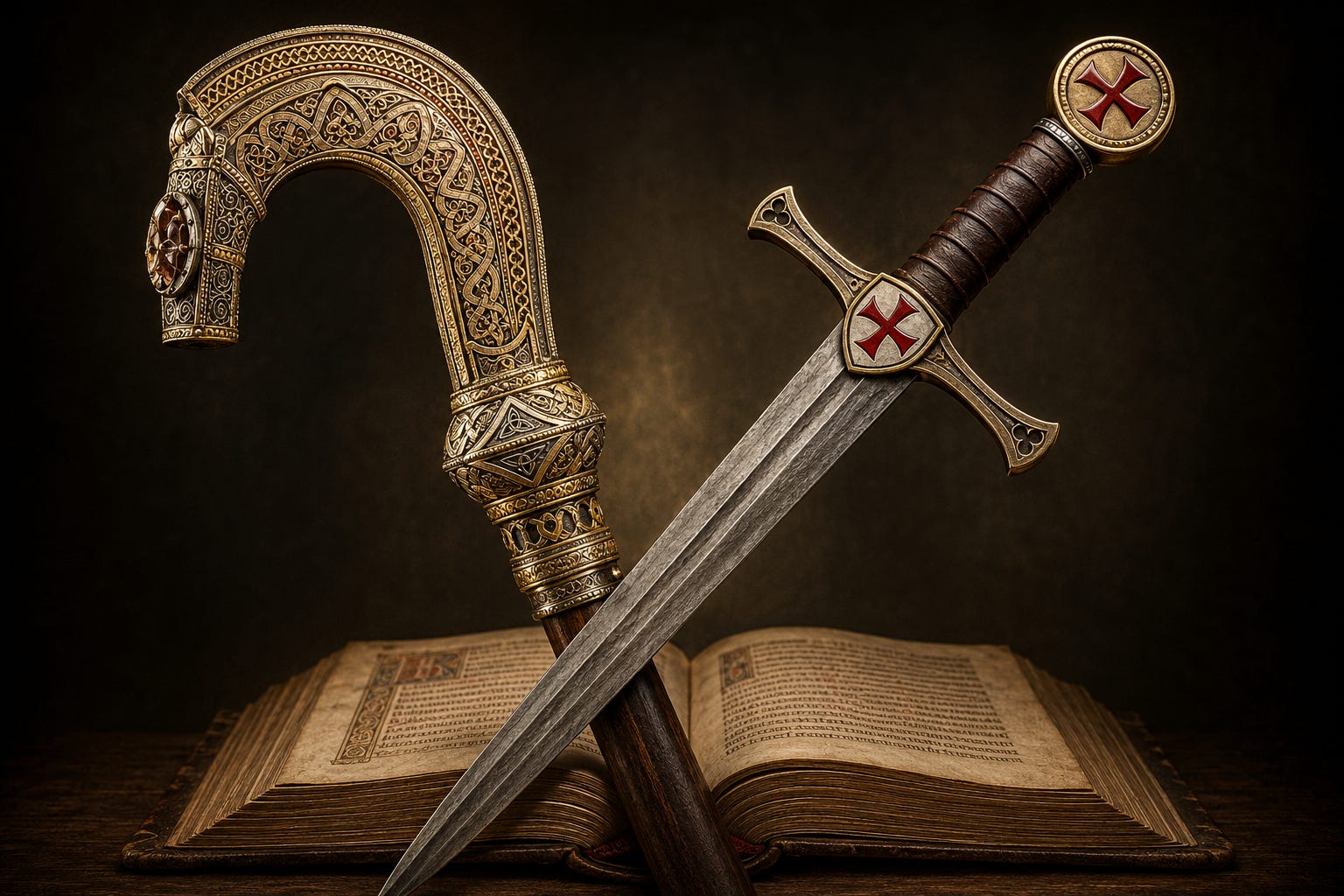
Most people know the Knights Templar through the Crusades, the Council of Troyes, and their eventual suppression. Far fewer have actually opened the Order’s historical manuals and examined what the Templar tradition says about its own spiritual foundations.
Our newly published study does exactly that.
The 1830 Manual of the Knights of the Order of the Temple makes an extraordinary claim: it identifies St. John the Apostle as “Sovereign Pontiff and Patriarch,” speaks of an Eastern Johannine succession, and declares that Hugh de Payens was “clothed with the Apostolic Patriarchal Power” and placed among the legitimate successors of John. The same Manual later explicitly describes the Templar Grand Master as “Sovereign Pontiff and Patriarch of the Order.”
But rather than simply repeating those claims, this new study asks how they fit into the wider historical record.
We follow the remarkable chain of John → Polycarp → Irenaeus → Gaul, examine Polycrates and the Asian bishops resisting Roman pressure on the ancient Paschal tradition, and explore the parallel Eastern connections preserved within Celtic Christianity—including St. David and Jerusalem, Iona’s abbots exercising authority over bishops, and Columbanus’ remarkable relationship with Rome.
Then we return to the Templars themselves: Jerusalem, the Eastern patriarchal tradition, 1129 Troyes, the Primitive Rule, the 1139 papal privileges, and the much larger question of what “patriarchal authority” actually meant in an early and medieval Church that was considerably more decentralized than many modern accounts suggest.
The article also provides links to the full 1830 Templar Manual, the Primitive Rule, Eusebius, Irenaeus, the Life of St. David, Omne Datum Optimum, and other primary texts, so readers can examine the evidence themselves.
Read the full study:
The Johannine Apostolic Tradition and the Knights Templar: Eastern and Celtic Church Traditions
This is part of our continuing Order Establishments research: recovering the documents, ecclesiastical foundations, rules, succession traditions, and historical framework necessary to understand the Order at a level deeper than popular Templar history.