

Our Analysis Models a 472% Increase in Breast Cancer Incidence: Why More Research Into Genetic Ancestry Is Long Overdue
How a little-studied area of genetics raises questions that deserve far more scientific attention.
One of the responsibilities of a free society is to ask difficult questions without fear of where the evidence may lead. Science advances by investigating unanswered questions—not by assuming certain topics are too controversial to examine.
Over the past several days, I set out to answer what I thought would be a straightforward question:
Has anyone seriously studied whether detailed genetic ancestry or multiracial ancestry influences disease susceptibility?
To my surprise, I repeatedly encountered the same answer throughout the scientific literature: very few studies have examined the question directly.
One of the clearest acknowledgements comes from a childhood cancer study by Chow et al.:
“Children of different racial/ethnic backgrounds have varying risks of cancer. However, few studies have examined cancer occurrence in mixed ancestry children.”
That sentence immediately caught my attention.
If genetics is widely recognized as playing an important role in disease susceptibility, why has so little research examined one of the most fundamental genetic variables available—genetic ancestry itself?
That question led us to one of the few published studies that approached the issue using modern DNA analysis rather than birth records or census categories.
A DNA-Based Study
The study by Fejerman et al. did something different from many earlier epidemiological studies.
Rather than simply recording how participants identified themselves ethnically, researchers estimated each participant’s ancestry using DNA ancestry-informative genetic markers. In other words, the ancestry estimates came from the genome itself.
Within the Latina population studied, the researchers reported that increasing European genetic ancestry was associated with higher breast cancer risk. They later identified a region on chromosome 6q25 that appears to explain part of this association.
That finding is scientifically interesting in its own right.
Our Analysis
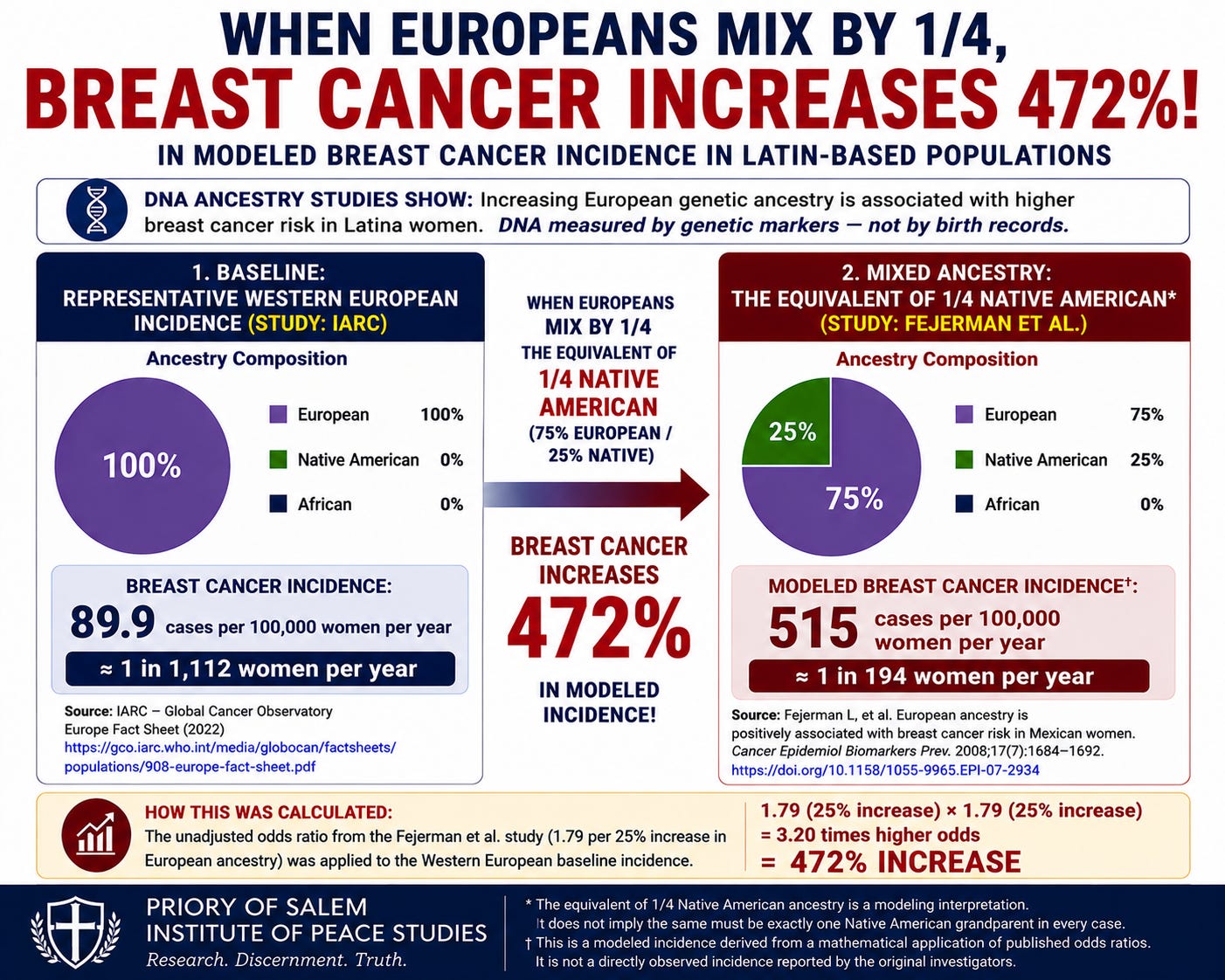
The infographic accompanying this article is not a reproduction of the study’s conclusions.
Instead, the Priory of Salem Institute of Peace Studies applied the study’s published unadjusted odds ratio to a representative Western European breast cancer incidence baseline published by the International Agency for Research on Cancer (IARC).
This produces a mathematical model illustrating how the reported association translates into modeled incidence under those assumptions.
The result is a modeled increase of approximately 472% relative to the selected baseline.
It is important to understand what this does—and does not—represent.
It is not a directly observed incidence reported by the original investigators.
It is a mathematical application of their published odds ratio to an independently published incidence baseline.
Readers are encouraged to examine both sources for themselves.
Why We Believe This Matters
At the Priory of Salem Institute of Peace Studies, we believe scientific inquiry should be guided by evidence rather than by whether a topic is socially comfortable or uncomfortable.
True peace is built upon reconciliation with truth, and truth is best pursued through careful, transparent, and unbiased research.
We are not presenting this as the final word on the subject.
Quite the opposite.
We are arguing that this area deserves far more scientific investigation than it has received.
If future research disproves today’s hypotheses, then science has still advanced.
If future research confirms them, society will have learned something important that might improve prevention, diagnosis, or treatment.
Either outcome is valuable.
Ignoring questions simply because they are controversial serves no one.
A Call for Better Research
Our hope is that future researchers will:
Collect more detailed DNA ancestry information.
Publish underlying datasets for independent analysis.
Study multiple diseases rather than isolated conditions.
Examine ancestry using modern genomic methods rather than broad census categories alone.
Encourage open scientific discussion regardless of where the evidence leads.
Science progresses through replication, transparency, and honest debate.
Questions should never be settled by social pressure; they should be settled by evidence.
Read the Full Members’ Report
The full research discussion, methodology, calculations, and source analysis are available to members of the Priory of Salem Institute of Peace Studies.
Visit:
https://CelticOrthodoxy.com/prioryofsalem
Members of the Institute receive access to extended research papers, historical investigations, and ongoing scientific reviews.
The complete report is also available to paid subscribers of Watchman.Report, where we regularly publish long-form investigative analyses unavailable in the public newsletter.
Thank you for supporting independent research and thoughtful discussion. Whether the evidence ultimately confirms or refutes today’s models, we believe these questions deserve to be investigated openly, honestly, and without prejudice.
Primary Sources
International Agency for Research on Cancer (IARC): Representative Western European breast cancer incidence.
Fejerman L., et al. European ancestry is positively associated with breast cancer risk in Mexican women.
Chow et al. Childhood Cancer in Relation to Parental Race and Ethnicity.