

At the end of this email, you’ll find a shareable MEME graphic that captures the heart of this message. If ultimately you find this has been meaningful to you, we encourage you to share it and help point others back to the full article at www.Watchman.Report.
Brethren,
Grace and peace to you.
In recent years, many—especially within Western Christianity—have encountered the claim that “Easter is pagan.” For some, this has caused confusion. For others, it has even led to distancing themselves from the historic celebration of the Resurrection.
But what if this claim is not only overstated—but fundamentally mistaken?
We have published a new article addressing this directly, carefully, and from Scripture, history, and the life of the Church:
👉 Read the full article:
https://celticorthodoxy.com/2026/03/easter-not-pagan-pascha-answer/
This is not about defending tradition for tradition’s sake—it is about restoring clarity, and more importantly, restoring Christ to the center of what has always been His.
Quick Overview (Key Points at a Glance)
Pascha = Passover fulfilled in Christ — not a pagan feast — The Resurrection celebration comes directly from the biblical Passover fulfilled in Christ.
No Church document ever says “adopt a pagan holiday” — There is no historical evidence of intentional pagan alignment.
Early Church debates were about timing, not paganism — The question was when, not whether.
“Easter” is a local English month-name, not the origin of the feast — A linguistic carryover, not theology.
Most of the world calls it Pascha, not Easter — The global Church preserves the Passover meaning.
No Easter Bunny in Rome, Italy, or the Orthodox world — A later Western cultural addition.
(Local folklore: Osterhase belongs to German/Saxon tradition, not Church teaching.)Eggs come from Lent fasting and Passover symbolism — Practical and biblical roots.
Folk customs are not Church doctrine — Cultural layers developed later.
“Fertility and Increase” — a biblical pattern of worship and reason of celebration — Not inherently pagan.
Babylonian-origin claims lack historical continuity — No real transmission chain exists.
Calendar differences do not equal pagan compromise — They reflect calculation methods.
Scripture: “the substance is Christ” (Col. 2:16–17) — The meaning is anchored in Him.
Scripture: days are regarded “unto the Lord” (Rom. 14:5–6) — Observance is directed toward God.
(Passover / Pascha is given as a holy convocation throughout all generations and dwellings.)Conclusion: A Clarification, a Return, and a Call to Faithful Assembly
A Word of Encouragement
The early Church did not gather around speculation, nor did it build its worship on borrowed myths. It gathered around Christ crucified and risen.
“Christ our Passover is sacrificed for us.” (1 Corinthians 5:7)
And we are exhorted:
“Not forsaking the assembling of ourselves together…” (Hebrews 10:25)
This is not merely about correcting an argument—it is about returning to a proper understanding of the faith once delivered, and standing together in the unity of the Church, proclaiming what has always been true:
👉 The feast is not about rabbits.
👉 It is not about confusion.
👉 It is about Christ.
“Which are a shadow of things to come; but the substance is Christ.” (Colossians 2:17)
We encourage you to read the full article, reflect on it, and share it with others who may be wrestling with these questions.
👉 Read this enlightening / in-depth article here:
https://celticorthodoxy.com/2026/03/easter-not-pagan-pascha-answer/
Standing together in truth and in Christ,
Watchman.Report
www.Watchman.Report
BONUS MEME:
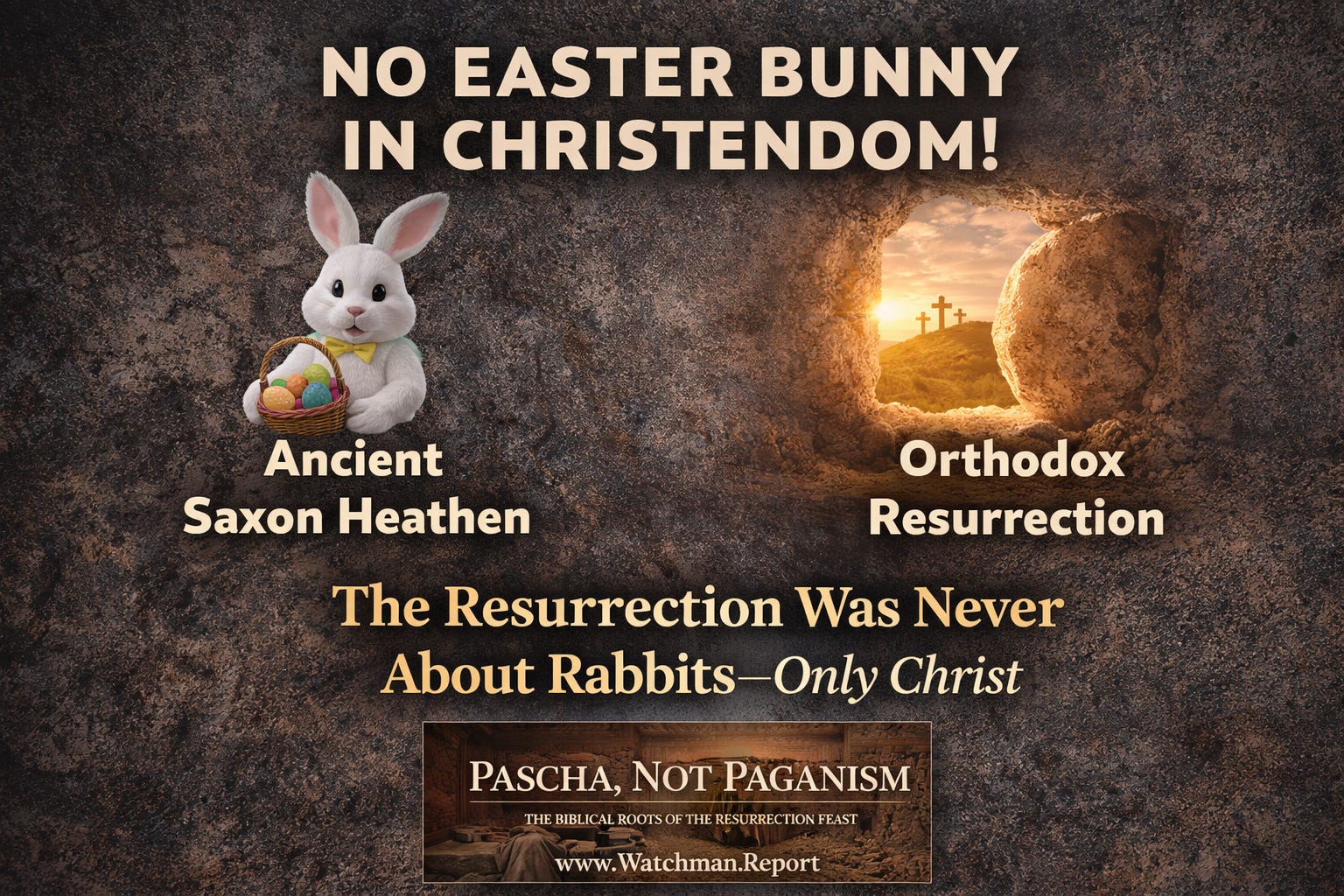
You can share this graphic with the following text:
Many claim that “Easter is pagan”—but is that really true?
The historical Christian feast is Pascha, rooted in Passover and fulfilled in Christ—not in paganism.
This article breaks it down clearly from Scripture, history, and the life of the Church.
👉 Read here:
https://celticorthodoxy.com/2026/03/easter-not-pagan-pascha-answer/