

Not Scattering, But Gathering
Recovering the Communion of Saints, the Ancient Celtic Church, and a Path Toward the Unity of the Body
One of the great burdens of the Church today is not simply that Christians disagree.
It is that disagreement so often becomes scattering.
Questions about the saints, Mary, prayer for the departed, intercession, invocation, images, and ancient Christian devotion have divided Christians for centuries. Too often one side feels required to defend every later expression, while another side feels compelled to reject almost everything associated with the historic practice.
We have been working to ask a different question:
What did the early Church actually believe and practice—and where did the Church itself draw the boundaries?
Our hope is not to create another argument.
It is to contribute toward the rebuilding of the Body.
Not scattering, but gathering.
Not excusing sin, but restoring the repentant.
Not abandoning the Body, but building it up—until we all come into the unity of the faith.
That spirit is behind a major new series of studies now published and substantially updated through CelticOrthodoxy.com.
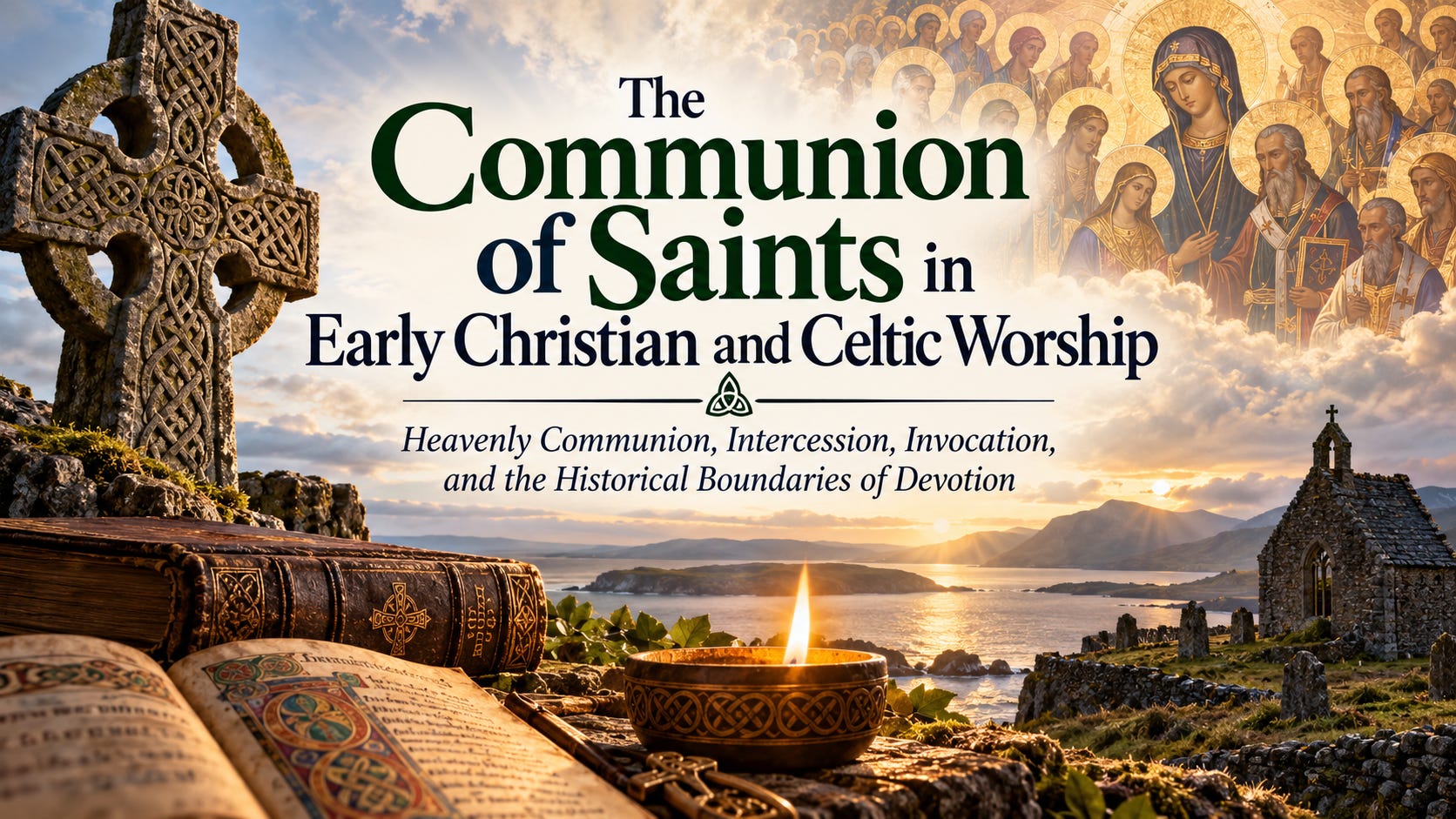
The Communion of Saints in Early Christian and Celtic Worship
Heavenly Communion, Intercession, Invocation, and the Historical Boundaries of Devotion
Our new thirteen-section cornerstone study follows the subject from its biblical foundations through its development in Celtic, Gallican, Insular, Eastern, and Western Christianity.
It examines:
the one Church in heaven and earth,
Hebrews 12 and the “spirits of just men made perfect,”
the innumerable company of angels and heavenly assembly,
the glory of God manifested in His saints,
prayer for the departed,
whether the saints continue to pray,
the difference between acknowledging heavenly intercession and directly requesting it,
the Stowe Missal and its manuscript layers,
early Irish and Insular evidence,
the Diptychs,
named remembrance and memorial prayer,
protective devotional language,
and the historical limits placed upon all of these practices.
Read: The Communion of Saints in Early Christian and Celtic Worship
One important result of the study is that the history becomes much clearer when we stop reducing everything to:
“Did Christians pray to saints or not?”
There were distinguishable forms.
The principal Celtic and Insular trajectory we found is:
heavenly communion and praise → intercession acknowledged before God → and, in later Celtic and Insular development, direct requests for intercession such as “Pray for us” and “Intercede for us.”
This distinction matters. The earliest Celtic material is much more clearly centered on heavenly communion, remembrance, and God-directed prayer. The direct ora pro nobis form becomes clearer in later Insular and Celtic witnesses.
In other words, the clearest later Celtic and Insular direct formulas are not requests for a saint to become an independent source of divine power.
As the practice developed into direct invocation, the formula became:
“Pray for us.”
“Intercede for us.”
That distinction is important.
The saint is directly addressed, but the action requested is prayer to God:
the saint intercedes; God hears and grants.
Stronger expressions such as “help,” “protect,” “defend,” or “save” certainly appear elsewhere in Christian history and secondarily in some Celtic protective or lorica traditions. But we have now made especially clear in the study that this Category D language is not the principal Celtic pattern.
The strongest Celtic and Insular evidence remains centered upon communion, remembrance, intercession, and “pray for us.”
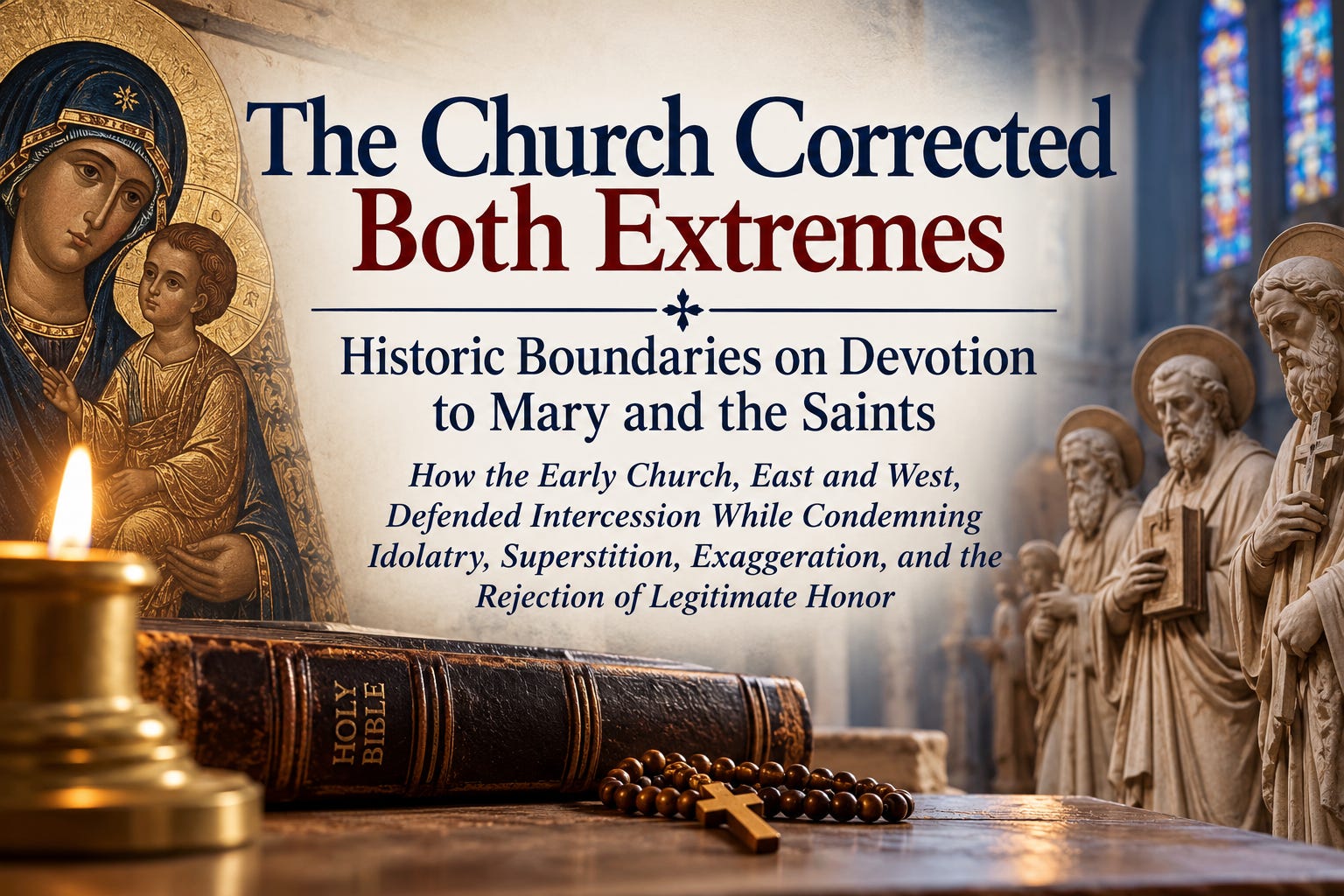
Church Boundaries on Devotion to Mary and the Saints
How the Church Corrected Both Excess and Rejection
Perhaps the most important companion study asks:
Did the historic Church itself ever say that devotion to saints or Mary could go too far?
The answer is clearly:
Yes.
But the Church also corrected the opposite extreme.
It did not teach that because abuses existed, Christians should therefore erase the saints, reject the heavenly communion, or deny legitimate intercession.
This article traces those corrections through:
the Council of Laodicea,
St. Epiphanius,
St. Augustine,
St. John of Damascus,
the iconoclast controversy,
the Council of Hieria in 754,
the Second Council of Nicaea in 787,
the Council of Trent,
Vatican II,
and Paul VI.
Read: Church Boundaries on Devotion to Mary and the Saints
What emerges is a remarkably consistent principle.
The Church defended legitimate honor and intercession while repeatedly rejecting:
treating saints as gods,
sacrifice offered to creatures,
independent saving power,
superstition,
exaggeration,
misleading devotional claims,
and practices that obscure or displace Christ.
At the same time, reform itself could become excessive when it attempted to destroy lawful remembrance, sacred honor, or belief in the continuing prayers of the heavenly Church.
The historical balance is therefore neither:
“Accept every devotional expression.”
nor:
“Erase the communion of saints.”
It is:
Honor without deification.
Intercession without rival mediation.
Devotion without superstition.
Reform without destruction.
Walking With the Saints — Our Main Study Hub
We have also substantially updated our main saints and communion-of-saints hub:
Walking With The Saints — The Communion of Saints in the Celtic Orthodox Church
This is now the accessible starting point for:
Celtic saints studies,
saints calendars,
CelticSaints.org,
liturgical resources,
St. Aengus the Culdee,
the Celtic Missal,
prayer for the departed,
the Stowe tradition,
and the deeper historical studies linked above.
For someone who does not want to begin immediately with a long manuscript or theological study, this is the best doorway into the series.
Prayer for the Departed in the Celtic and Early Church
We have also substantially expanded our study:
Prayer for the Departed in the Celtic Church and Early Christianity
It now places early Christian and Celtic memorial prayer within the larger communion of the Church and examines:
Tertullian,
Cyril of Jerusalem,
Chrysostom,
Monica and Augustine,
Irish canonical evidence,
Columba and the Columban tradition,
Gallican prayer,
St. Gall,
the Stowe Missal,
early inscriptions,
and the ancient Diptychs.
The study also makes much clearer the difference between:
praying for the departed
and:
asking glorified saints to pray for us.
These belong to the same wider communion, but they are not the same action.
We have also expanded the practical material concerning:
Diptychs of the living,
Diptychs of the departed,
saints of the day,
names remembered before God,
and candles as visible signs of prayer and remembrance rather than magical objects.
Recovering Our Own Saints
There is another important piece of this work.
The communion of saints should not remain an abstract theological argument.
We should actually know the people who carried the Christian faith before us.
St. Arsenios of Paros is widely remembered as saying:
“The Church in the British Isles will only begin to grow when she begins again to venerate her own Saints.”
Whatever Christian tradition a person presently belongs to, there is something powerful in that principle.
Before arguing about every detail of saintly invocation, Christians can at least begin by asking:
Who were our saints?
Who evangelized Britain, Ireland, Scotland, Wales, Cornwall, and the Celtic world?
Who built the monasteries?
Who crossed seas as missionaries?
Who preserved Scripture and Christian learning?
Who gave their lives as martyrs, bishops, abbots, missionaries, mothers, kings, hermits, teachers, and confessors?
That recovery itself can become an instrument of unity.
1,000 British & Celtic Saints Before Augustine — Free PDF
We have therefore also published a major free resource:
1,000 British & Celtic Saints Before Augustine
This work gathers the historic witness of the ancient British and Celtic Churches before the mission of Augustine of Canterbury.
The downloadable reference edition includes principal saints from:
Britain,
Ireland,
Scotland,
Wales,
Cornwall,
Brittany,
and the wider Celtic Christian world.
It includes saints drawn from ancient martyrologies, chronicles, ecclesiastical histories, calendars, monastic traditions, and regional Christian memory.
It is meant not merely as a reference catalogue, but as an invitation to rediscover:
their faith, their missionary zeal, their courage, and their holy examples.
Read the article and download the FREE PDF: 1,000 British & Celtic Saints Before Augustine
There is also a companion calendrical form, arranging this wider heritage according to annual commemorations and daily liturgical use.
This gives us two complementary ways of approaching the saints:
historically and chronologically — seeing the development and spread of the ancient Church,
and:
calendrically — remembering these witnesses throughout the Christian year.
And this is material people can actually share.
Someone does not first have to settle every Catholic, Protestant, or Orthodox theological question before appreciating the story of the men and women who built Christian civilization in the Celtic lands.
Give the PDF to someone interested in:
Irish history,
Scottish history,
Welsh culture,
Celtic heritage,
ancient Britain,
genealogy,
local history,
Christian history,
or simply remarkable lives from the past.
The saints can become a doorway.
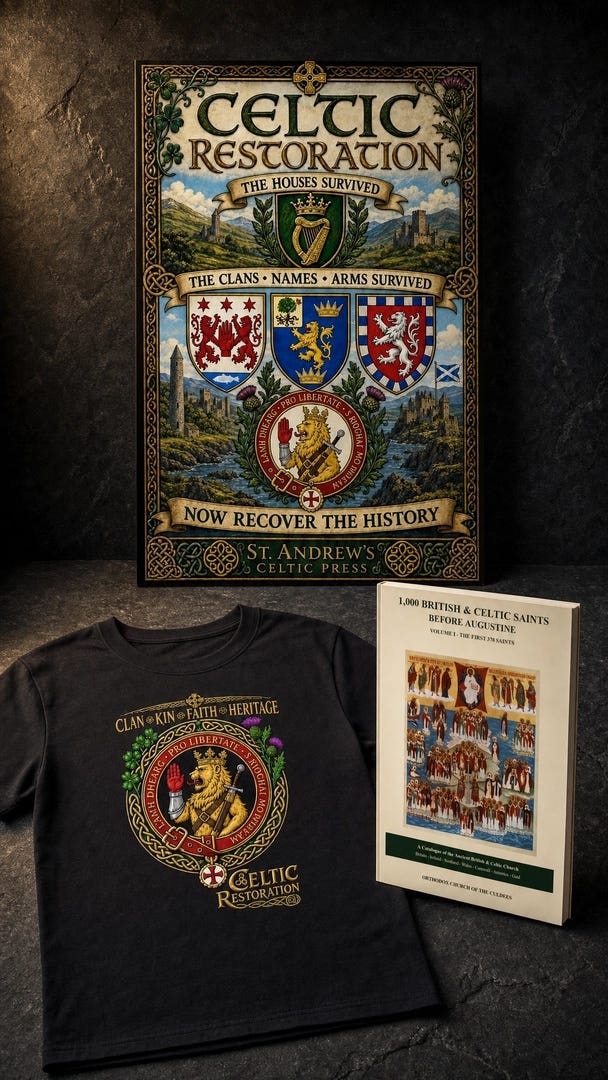
Taking the Restoration Beyond the Church Walls
This is also part of why we continue producing printed material, books, heritage displays, shirts, posters, and literature for Celtic festivals and broader public outreach.
Not everyone who walks past a Celtic festival booth is prepared for a discussion about the technical theology of saintly intercession.
They may simply say:
“My family is Scottish.”
“I am researching my Irish ancestry.”
“I didn’t know Christianity was established in Britain that early.”
“Who were these saints?”
That is already a beginning.
The restoration of Christian memory can begin with history, heritage, a name, a clan, a monastery, an old Celtic cross—or one remarkable saint.
From there, someone may discover an entire Christian inheritance they never knew existed.
See the latest Celtic Restoration outreach materials
Our recent short promotional video shows three of the newest pieces together—including the 1,000 British & Celtic Saints Before Augustine work:
Watch the short Celtic Restoration promo video
We encourage others to do the same kind of thing in whatever way is available to them.
Share a PDF. (such as found on the St Andrew’s Celtic Press site: https://celtic.press/journal/celtic-kingdom-restoration/)
Give someone a booklet.
Send an article to a friend.
Bring literature to a Celtic festival.
Introduce someone to the saint associated with their town or ancestral homeland.
You do not need to settle every theological disagreement in the first conversation.
Sometimes restoration begins simply by helping someone remember what was forgotten.
Why This Matters for the Unity of the Church
This brings us back to the larger purpose of the entire series.
We are living in a time when Christians often react to error by withdrawing from one another.
A bad pastor becomes an argument against pastors.
An abuse of authority becomes an argument against authority.
A devotional excess becomes an argument against the communion of saints.
A sinful member of the Body becomes someone to be permanently cast away even when repentance and restoration remain possible.
But Scripture gives another picture.
Christ gave ministries:
“for the perfecting of the saints, for the work of the ministry, for the edifying of the body of Christ…”
until:
“we all come in the unity of the faith.”
— Ephesians 4:12–13
The answer to disorder is not the destruction of the Body.
The answer is restoration.
The answer to misuse is not automatically abolition.
The answer is correction.
The answer to scattering is gathering.
And perhaps rediscovering the faithful Christians who came before our present divisions can help us remember that the Church is larger than many of the controversies by which we presently identify ourselves.
An Orthodox Christian can honor these saints.
A Catholic can honor them.
An Anglican can remember them.
And even a Protestant who rejects invocation of saints can still study their lives, thank God for their faithfulness, and be edified by their Christian example.
We may disagree about exactly how far devotion should go.
But surely Christians can begin together by refusing to forget those through whom God worked.
That is part of the principle we hope these studies and resources help recover:
Not scattering, but gathering.
Not excusing sin, but restoring the repentant.
Not abandoning the Body, but building it up—until we all come into the unity of the faith.
There is room within that work for careful correction.
There is room for historical honesty.
There is room to recognize that some devotional language developed later.
There is room to say that some practices went too far.
And there is room to recognize that the saints remain witnesses to the work of God, that the Church did not begin yesterday, and that our Christian inheritance should not simply disappear because later generations disagreed about how parts of it should be understood.
Our prayer is that these studies help Christians approach these questions with greater confidence, greater charity, and greater faithfulness to Christ.
Begin here:
Walking With The Saints — Main Study Hub
Then continue with:
The Communion of Saints in Early Christian and Celtic Worship
Church Boundaries on Devotion to Mary and the Saints
And share freely:
1,000 British & Celtic Saints Before Augustine — Free PDF
Please share these studies and resources with others who have wrestled with these questions—or simply with someone who loves Celtic history and deserves to know the Christian inheritance of these islands.
Not merely so that we may win another argument—
but so that we may remember, restore, gather, and build up the Body.
“Endeavouring to keep the unity of the Spirit in the bond of peace.”
— Ephesians 4:3