

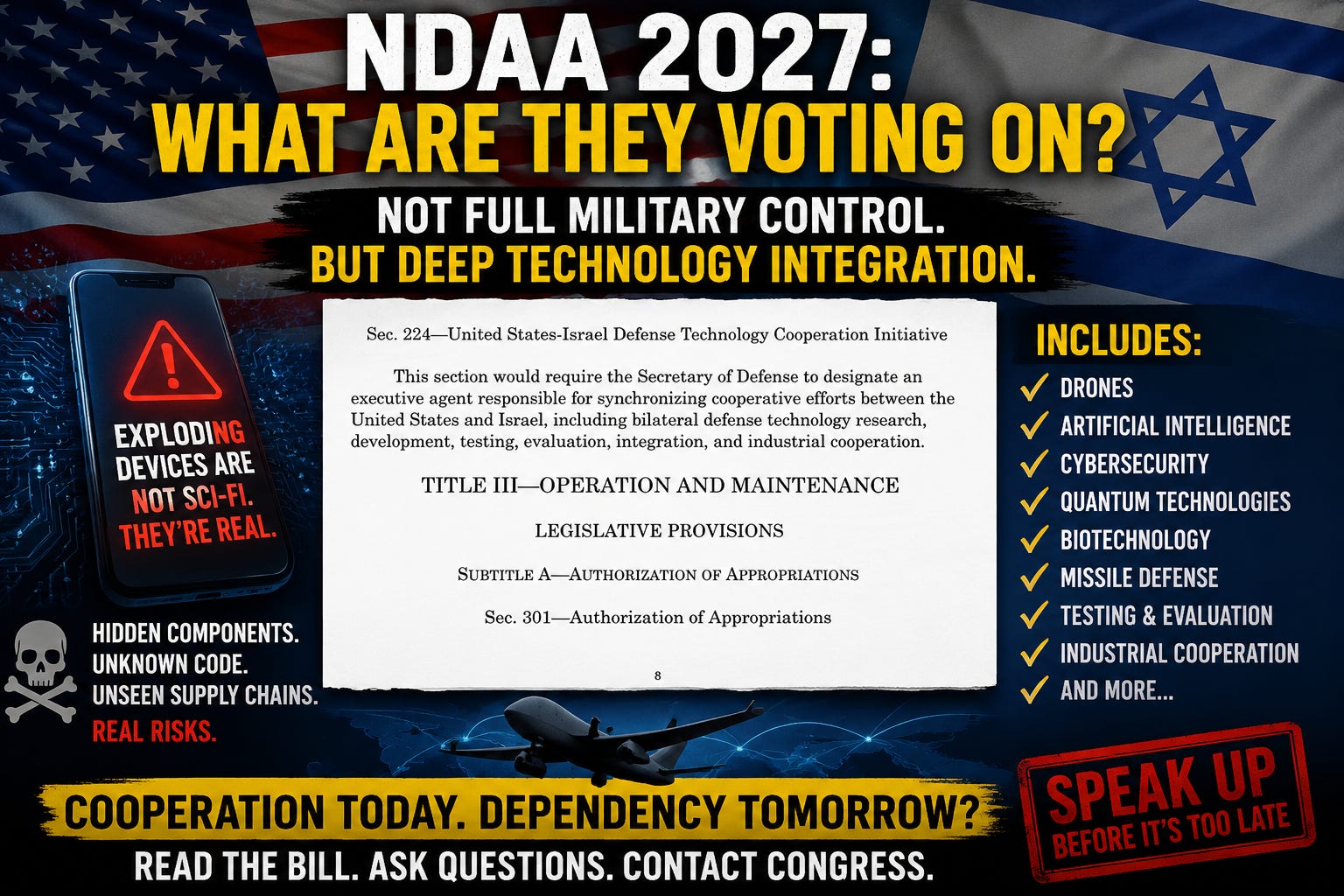
NDAA 2027: Do We Really Want More Foreign Technology Integration?
Congress is considering a major expansion of U.S.-Israel defense technology cooperation. Before the vote, Americans should understand exactly what is being proposed.
Dear Friends,
Remember the exploding pagers that shocked the world?
What many people missed was the larger lesson.
Modern technology is built from thousands of components, firmware updates, software libraries, subcontractors, and suppliers. Most consumers have no idea where all those pieces come from. Neither do many corporations.
Now Congress is considering a proposal in the FY2027 National Defense Authorization Act (NDAA) that would significantly expand U.S.-Israel defense technology cooperation in areas such as drones, artificial intelligence, cybersecurity, military communications, logistics, biotechnology, quantum technologies, and other advanced systems.
Before we go any further, I encourage everyone to read the actual text for themselves.
FY2027 NDAA Chairman’s Mark (Section 224):
https://armedservices.house.gov/uploadedfiles/fy27_ndaa_chairmans_mark_-_final.pdf
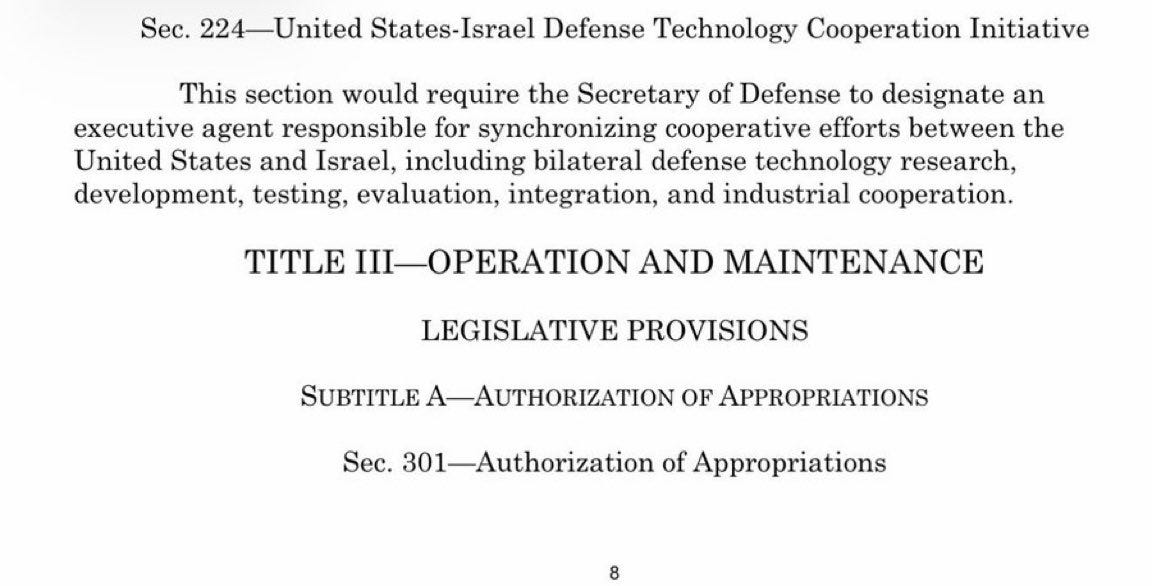
The proposal concerns defense technology integration and cooperation. Readers should review the actual text and decide for themselves whether this level of integration is appropriate.
Supporters argue that America needs stronger drone capabilities and faster innovation. There is certainly truth to that. Recent conflicts have shown that inexpensive drones and advanced software systems are changing warfare at a rapid pace.
But there is another question:
Do we really want deeper integration of critical technologies with any foreign nation?
This is not about whether a country is friend or foe today.
History changes.
Governments change.
Alliances change.
The real issue is dependency.
Who builds the components?
Who writes the firmware?
Who controls the updates?
Who audits the code?
Who has access to the supply chain?
Who ultimately controls the intellectual property?
The exploding pager incident reminded the world that technology can be weaponized in ways few people imagined. Modern devices increasingly depend upon hidden layers of hardware, software, firmware, and communications systems that most users never see.
The more interconnected these systems become, the more important transparency and security become.
The NDAA proposal may be intended to improve military technology cooperation. However, Congress should proceed cautiously whenever critical technologies become more deeply integrated across national borders.
Technology cooperation can provide benefits.
But once dependencies are built, they are often far more difficult to remove.
Americans should carefully read what is being proposed and decide for themselves whether this level of technology integration serves the long-term interests of the United States.
If you have concerns, contact your U.S. Representative and Senators and ask them to review the technology integration provisions of the FY2027 NDAA before voting.
Read the bill.
Ask questions.
Contact Congress.
An informed citizenry remains the best defense against unintended consequences.
Further Reading:
Watchman News: https://watchman.news
Technology & Transhumanism Watch:
https://watchman.news/transhumanism-agenda-news-watch/
Related Article:
“An Exploding Phone Near You”
https://www.watchman.report/p/an-exploding-phone-near-you
Blessings,
Dr. Stephen M.K. Brunswick
Editor, Watchman News
