

Heavenly Participation in Early Christian Liturgy
This week, I want to share something that surprised me—and may challenge the way many of us have understood a familiar phrase in Christian worship.
It begins with an ancient prayer.
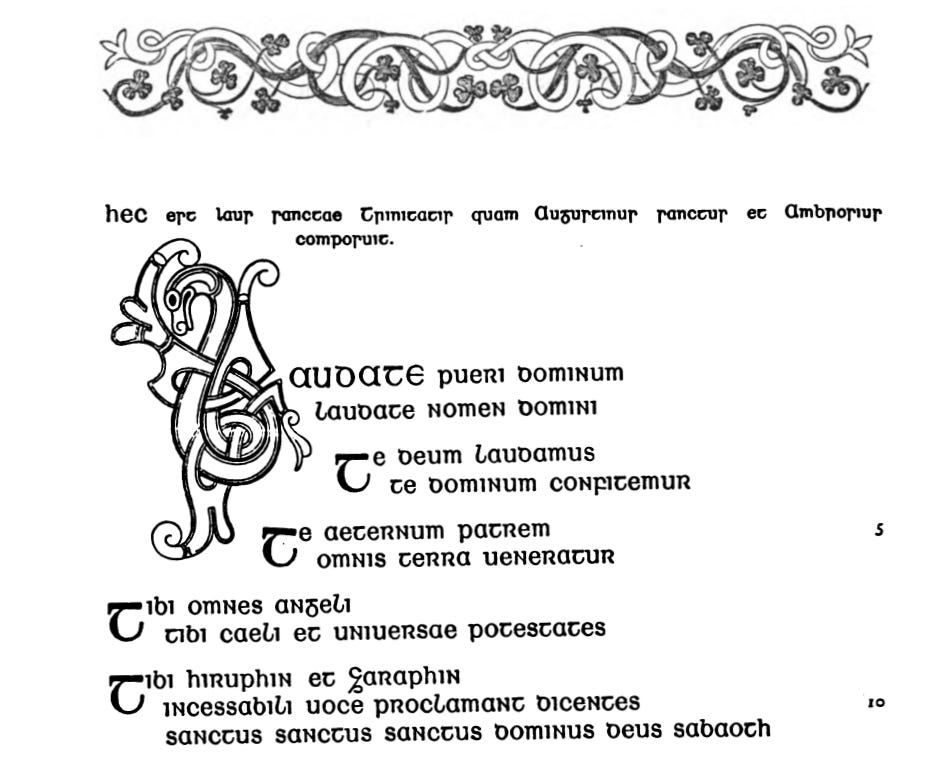
Not a modern one, not a reconstruction—but a form preserved in the early Celtic Church, reflected in a 7th-century Irish rendering of the Te Deum.
When you read it carefully, something becomes clear:
The earliest Christians were not simply asking the saints to “pray for us” in the way we often assume today.
They were doing something deeper.
📖 The Scriptural Foundation
Scripture tells us:
“We are compassed about with so great a cloud of witnesses…” (Hebrews 12:1)
“You are come… to the spirits of just men made perfect…” (Hebrews 12:23)
This is not language of separation.
It is language of participation.
The Church on earth is not alone—it stands within a greater reality, joined to the saints in heaven.
🕊️ What the Earliest Liturgies Show
As I began comparing early manuscripts—Irish, Gallican, and Eastern—I expected to find a consistent pattern.
Instead, I found something more nuanced.
In the earliest sources:
the saints are described as praising God continually
the Church on earth is seen as joining that praise
and in times of need, believers pray that God would allow their help to surround and strengthen His people
Only later do we begin to see the repeated formula:
“pray for us”
⚖️ Not a Rejection—But a Recovery
This isn’t about rejecting tradition.
It’s about understanding it more fully.
The early Church did not deny the intercession of the saints.
But it expressed that reality in multiple ways:
praise
participation
protection
and prayer directed to God
Over time, those expressions became more uniform—simplified into familiar formulas.
Something important was preserved.
But something of the original richness may also have been… compressed.
✨ Why This Matters
For many Christians today, this topic can be difficult.
Some are uncomfortable with invoking saints.
Others feel it is essential.
What I’ve found is that much of the tension comes not from the belief itself—but from how the language is understood.
When we return to the earliest sources, we begin to see something that both sides can recognize:
The Church is one—heaven and earth together—standing in Christ.
📚 The Full Study
I’ve put together a detailed study working directly from early manuscripts, including:
the Antiphonary of Bangor (7th century)
the Irish Lorica tradition
the Stowe Missal (8th–9th century)
and later developments such as the Dunkeld litany
If you’d like to explore this more deeply:
👉 Read the full article here:
https://celticorthodoxy.com/2026/05/heavenly-participation-in-early-christian-liturgy-praise-protection-and-the-origins-of-saintly-petition
🕯️ A Final Thought
One of the most beautiful lines preserved in the ancient prayers says:
“The glorious company of the Apostles praise Thee…
The noble army of Martyrs praise Thee…”
Before we ever asked the saints to pray for us,
the Church first understood that:
they were already praising God—and we were joining them.
If this resonates with you, I’d love to hear your thoughts.
In Christ’s eternal service,
+Rev Dr Stephen M.K. Brunswick, ThD, PhD
Primace at St Andrew’s OCC
Phone: +1 (866) 477-6811
Email: info@st-andrewsocc.org
Web: https://St-AndrewsOCC.org
Post: St Andrew’s PO Box 59, Nevada, MO 64772
Presiding Bishop, AOCC Benelux (2015-Present)
Primace, Orthodox Church of the Culdees (2009-Present)
Pastor, TCA WW (2001-Present)
+ Oremus pro invicem +